

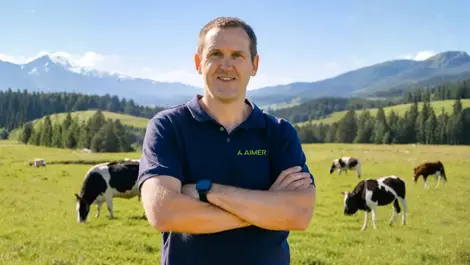
Aimer Farming appoints Shane Nolan as Chief Revenue Officer

Aimer Farming has appointed Shane Nolan as chief revenue officer, adding a senior agribusiness executive to the technology company's leadership team.
Nolan brings more than 20 years of experience across New Zealand agribusiness and agritech. He previously held senior roles at RX Plastics, Datamars New Zealand and Tru-Test Group, focusing on commercial growth and farmer adoption of technology.
His appointment comes as Aimer Farming looks to expand sales, partnerships and customer relationships for its pasture measurement product, AIMER. Nolan will focus on growing the customer base and supporting the rollout of additional measurement methods, including satellite- and drone-based pasture assessment.
AIMER is designed to measure and forecast pasture growth using smartphone-based computer vision and proprietary algorithms. Farmers scan part of their farm with the app, which estimates the remaining pasture cover and produces forecast feed wedges and grazing plans.
Aimer Farming says this approach can reduce time spent on farm walks while giving farmers more regular data on pasture performance. In New Zealand's dairy sector, pasture management remains closely tied to feed costs, milk production and farm efficiency.
Nolan said pressure on dairy farmers is increasing as they manage time constraints, labour shortages and tighter environmental expectations. He said those pressures are driving demand for simple decision-making tools that turn pasture data into practical on-farm actions.
"Pasture management has always been central to dairy farming in New Zealand, but its importance is only increasing as environmental pressures intensify. Kiwi dairy farmers are grass farmers, and pasture is what ultimately converts to milk in the vat.
"The more homegrown pasture you can grow and utilise efficiently, the more it helps address long-term environmental challenges. It's also the lowest-cost feed on farm, so improving pasture utilisation can reduce reliance on supplementary feed and lift a farm's overall efficiency," Nolan said.
He said the market is shifting from tools that only measure pasture to systems that also interpret information and suggest actions. That reflects a broader trend in agricultural software, as vendors try to reduce the time farmers spend handling raw data.
"Farmers don't have time to delve into complex information. They want technology they can trust to guide their decisions," Nolan said. "We completely trust Google Maps now and that's where pasture management technology is heading."
Aimer Farming argues that consistency and ease of use remain major barriers in pasture measurement. Manual assessment can be labour-intensive and vary between users, creating gaps in the data farmers rely on for grazing and feed planning.
"Collecting reliable pasture data has traditionally been time-consuming and inconsistent, and AIMER makes it very easy," Nolan said. "AIMER's ability to provide real value on farm - from time saved and labour reduced to more consistent pasture performance - is what sets it apart."
Next stage
Nolan expects pasture technology to move further towards automated recommendations, with software prompting farmers to make grazing or silage decisions directly from incoming data. That would shift these systems from measurement tools to operational decision support.
"Farmers are going to be served insights straight from the data," Nolan said. "It'll tell you: move the cows into this paddock today for optimisation or lock these paddocks up for silage - and then ask if you want it actioned."
He also described strong early feedback from farmers and industry contacts since taking up the role. He said much of the response focused on the time the app can save and confidence in the consistency of smartphone-based pasture measurement.
"I've been out at regional field days and the NZ Dairy Expo and was blown away by the number of farmers telling me how much they like AIMER - how much time it's saving them, and how surprised they are that a smartphone app can measure pasture so accurately and consistently," Nolan said.
Aimer Farming was founded by chief technology officer Jeremy Bryant, who said the business had reached an important point in its commercial development. He said Nolan's hiring reflects the company's push to widen adoption in New Zealand and build a presence in overseas markets.
"Shane brings a wealth of sector experience and a genuine connection with farmers. He has spent his career helping farmers adopt technology that improves performance. His commercial leadership, industry relationships and practical understanding of on-farm decision-making will be invaluable as we scale AIMER across New Zealand and internationally," Bryant said.
Nolan is based in Canterbury and works with Aimer Farming's team in Hamilton.