

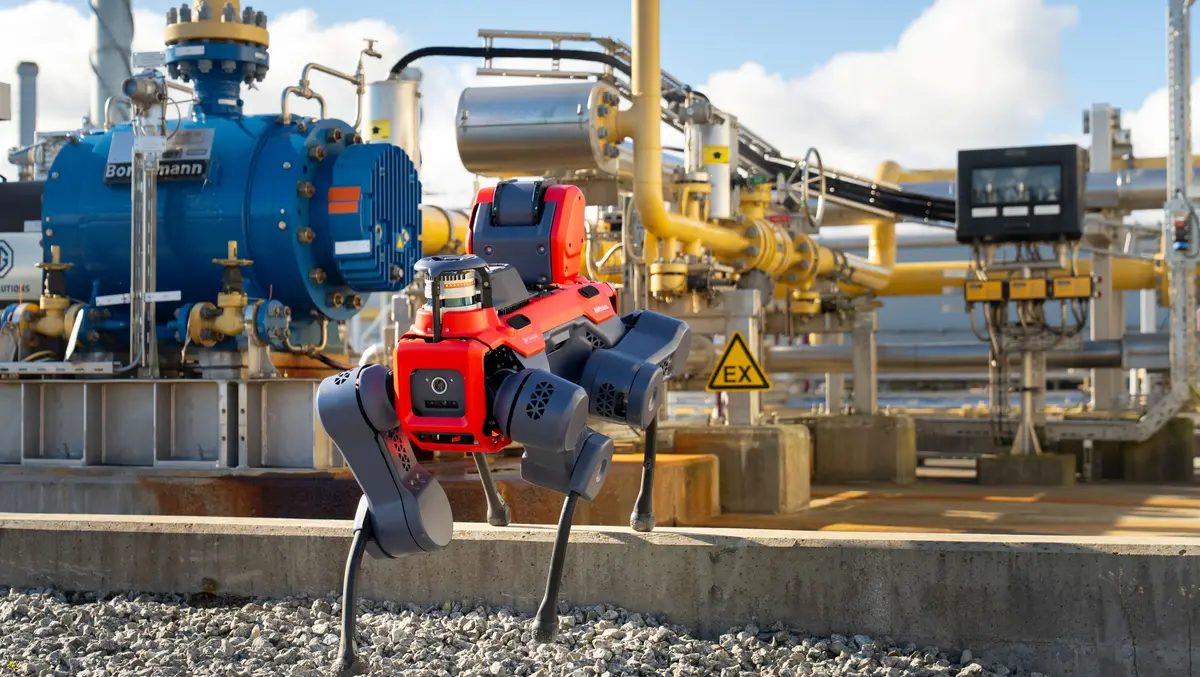
ANYbotics begins deliveries of explosive-zone robot
Tue, 10th Nov 2026 (Yesterday)
ANYbotics has started customer deliveries of ANYmal X, a legged inspection robot designed for use in explosive atmospheres. The first shipments include orders for Equinor and DSM-Firmenich.
The Zurich-based robotics group developed the machine for inspection work in oil, gas and chemical facilities, where workers often still have to carry out checks on foot in hazardous zones. The robot has been designed to meet ATEX and IECEx requirements for explosive environments.
ANYmal X is intended to automate routine inspection rounds in areas where standard robots are not permitted. It can move through industrial sites without facility modifications, including on steep stairs and narrow walkways, while using thermal, visual, acoustic and gas sensors to record readings linked to specific assets.
These inspections cover equipment such as pumps, compressors, valves and pipework. The data gathered is intended to help reliability engineers identify overheating, leaks, unusual noise and wear before they become larger operational problems.
Energy and chemical companies including BP, Equinor, Shell, PETRONAS, Petrobras, BASF and SLB have tested the robot since 2023 through an early access programme, according to ANYbotics. The company said the trials covered hundreds of onshore and offshore missions and helped shape the version now being delivered to customers.
"Four years of pioneering engineering with more than ten patents went into ANYmal X," said Péter Fankhauser, Co-Founder and CEO, ANYbotics.
"Many experts thought a legged robot could never be made safe for explosive atmospheres. Oil, gas and chemical plants are among the most hazardous and most costly places to operate. That makes them the prime case for physical and industrial AI, yet until now the areas that matter most were off-limits to robots like ours. That changes today," Fankhauser said.
Safety design
One of the central engineering challenges was making a mobile walking robot compliant with explosion-protection rules usually applied to smaller devices or fixed industrial equipment. Unlike static systems, a legged robot must combine motors, a battery, sensors and docking systems within a lightweight frame.
ANYbotics said it carried out an ignition-risk assessment across the robot's service life and added safeguards for each potential ignition source. According to the company, the AI computer and inspection equipment sit inside nitrogen-filled sealed chambers, while the battery and all 12 leg actuators are enclosed in flameproof casings.
Non-metallic shells insulate metallic parts, conductive feet provide grounding and automatic cut-offs monitor temperature, the company said. Charging and data transmission are also separated through energy barriers so that no connection is exposed to hazardous areas.
"We asked one question over and over: which credible event in the life of a walking robot could create an ignition source, and how do we make sure it never does?" said Andrea Corda, CTO, ANYbotics.
"Working closely with the certification bodies, we answered that question component by component. The result is a new explosion-protection approach for an entire class of autonomous mobile robots," Corda said.
Inspection market
ANYbotics said oil, gas and chemicals represent the largest market for autonomous inspection, valuing the sector at USD $102 billion. It said the economics are driven by the cost of skilled labour for manual inspection and the financial impact of preventable equipment failures.
The company also pointed to wider industrial losses from unplanned downtime, citing an annual figure of roughly USD $1.4 trillion for the world's 500 largest companies. In oil and gas, it said, a single hour of unplanned downtime can cost up to USD $500,000.
ANYmal X is being sold as part of a broader inspection system that includes Shift, the company's software platform for autonomous industrial inspection. According to ANYbotics, the platform schedules missions, organises findings by asset and links results to plant systems including SAP, Yokogawa and SLB.
Thierry Obédé, Chief Revenue Officer, ANYbotics, said a robot alone would not be enough for operators in hazardous industries. He said the system had to connect inspection data to maintenance processes already used on site.
"A certified robot is only the entry ticket for inspecting oil, gas, and chemicals facilities. ANYmal X is a complete end-to-end inspection solution built for performance, safety, and security. It combines autonomous navigation, industrial AI for data interpretation, and integrations that convert findings directly into maintenance work orders. Today, more than 50 power, metals, and materials customers use this system to run over 120,000 autonomous inspections every month," Obédé said.
The wider system is developed and operated under ISO 27001 standards for data protection, the company said. It added that the robot's repeatable inspection data can also support digital planning models such as digital twins by adding structured observations from plant rounds.
"Plants run on process data from their control systems and business data from their ERP," Obédé said.
"The third source, what operators see, hear and measure on their rounds, has always been manual. ANYmal X now captures it autonomously, even inside hazardous areas, and we stand behind the whole chain, from the robot on site to the work order in the maintenance system," he said.