

Chainguard adds Fulfilment Dashboard, expands Helm focus
Tue, 17th Feb 2026
Chainguard has added a new Fulfilment Dashboard for customer requests and expanded its catalogue of vetted Helm charts, broadening its focus from container images to the wider Kubernetes deployment process.
The updates emphasise self-service requests for software artefacts and more packaged Kubernetes deployment configurations. Chainguard says the changes are designed to reduce manual work for platform and DevOps teams managing open source components at scale.
Request tracking
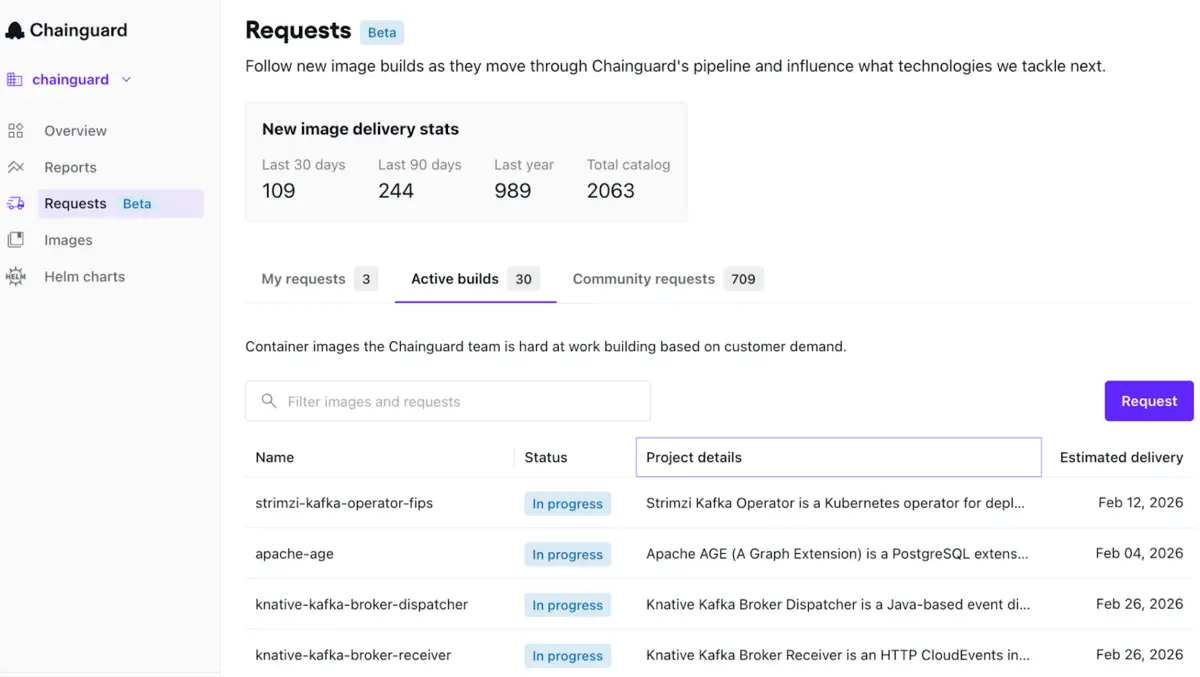
The Fulfilment Dashboard, available in the Chainguard Console, gives customers a single place to submit and track requests for new container images and related artefacts. It also adds voting, allowing users to upvote requests already in the pipeline.
The dashboard shows request status across stages including "In Review," "Active Builds," and "Delivered," along with target delivery dates. Integrated search and deduplication highlight similar or identical requests before a new one is submitted.
Chainguard says the workflow reduces reliance on informal communication, such as email threads and internal messaging, when teams are waiting for new images or updates.
Upvoting is a notable addition because it brings demand signals into the queue. Customers can see what other organisations are requesting and register interest in the same artefacts, which may influence prioritisation.
Automation layer
Chainguard has linked the dashboard to Chainguard Factory, its automated build system that monitors, builds, tests, and publishes software artefacts sourced from open source projects.
A newer version, Chainguard Factory 2.0, uses "agentic reconciliation bots" branded DriftlessAF. Chainguard says the system continuously rebuilds more than 2,000 open source projects and maintains "zero CVEs".
The dashboard targets customers that regularly request catalogue additions, including platform teams in large organisations with multiple stakeholders submitting requests.
Helm expansion
Chainguard has also expanded its Helm chart catalogue and updated related interfaces in its console and directory. Helm is widely used as a package manager for Kubernetes, bundling application configuration into charts that define resources in YAML.
Many organisations rely on community-maintained Helm charts to deploy common software in Kubernetes clusters. These charts can require manual updates and adaptation when teams use alternative container images or different security baselines. Teams also need to verify provenance and assess default settings before deploying to production.
Chainguard says the expanded catalogue includes both community charts and charts designed to work with its container images. It also says the charts are packaged as signed OCI artefacts built from source, with provenance attestations tied to source commits.
The charts pin dependent images by digest to ensure deployments reference a specific image build rather than a mutable tag. Chainguard also says it runs functional testing by deploying charts into a representative environment and checking core behaviour across supported image versions.
Chainguard expects the catalogue to expand further, saying it is "leveraging our robust automation and Chainguard Factory 2.0 to reach hundreds of additional charts by the end of the year".
Console changes
Chainguard has updated the Helm user experience in the Chainguard Console and Directory, describing an "Artifact Hub-like" interface. The new views show chart metadata, version history, and the specific images and versions associated with a chart.
A new view also surfaces values.yaml in the interface. Chainguard says users can query YAML by key, copy configurations, or download the file. values.yaml is commonly used to configure a Helm release and often includes image references, resource limits, and other deployment parameters.
The move reflects a broader shift in Kubernetes operations as organisations try to standardise deployment configurations and reduce bespoke chart forks. It also underscores the growing emphasis on supply chain security, with teams increasingly evaluating both the images they run and the configuration artefacts that define how those images are deployed.
"Today, we are excited to introduce Fulfilment Dashboard," Chainguard said.
"We've also upgraded the Helm experience within the Chainguard Console and Directory to provide an 'Artifact Hub-like' experience."