

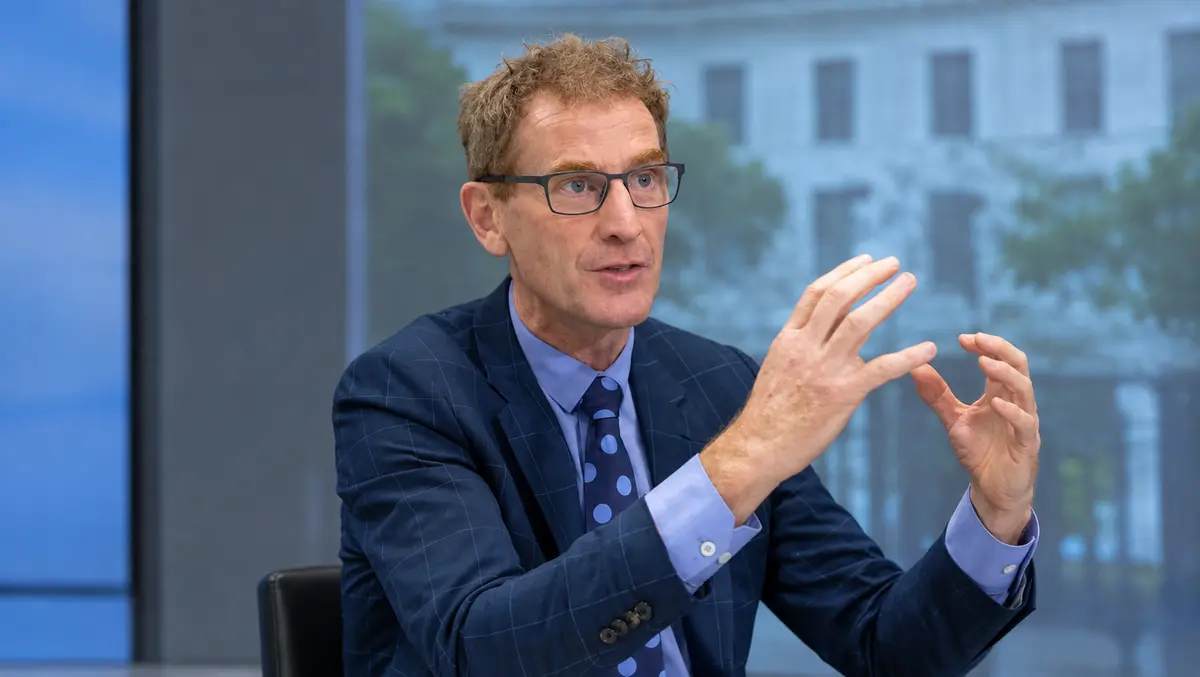

New Zealand Security Intelligence Service Director-General Andrew Hampton called for an all-of-society response to national security threats in a speech to the RNZAF Intelligence Conference, saying the country faced a more contested and volatile security environment.
He said the threats facing New Zealand and the wider Pacific included violent extremism, terrorism, espionage, foreign interference, insider risks and covert attempts by state actors to access or establish dual-use technology. Those pressures, he said, were being intensified by geopolitical competition, growing polarisation and rapid technological change, including generative artificial intelligence.
He also pointed to the impact of armed conflicts overseas, naming Ukraine, Gaza, Iran and Sudan. Hampton said New Zealand felt the effects through living costs and hostility directed at people with real or perceived links to those conflicts.
Another concern, he said, was the use of grey zone or hybrid warfare tactics by states, including cyber-attacks, disinformation and misinformation campaigns, the use of proxies such as criminal groups, and potentially maritime blockades.
Military links
Hampton paired those warnings with an account of the long-standing relationship between New Zealand's intelligence agencies and the New Zealand Defence Force. He described it as rooted in history and central to national security, with the NZDF assisting with intelligence collection and the intelligence agencies supporting military operations, cyber security, protective security and security clearance vetting.
Military intelligence staff perform a critical role when New Zealand deploys personnel into conflict zones, he said. "The most important function you as military intelligence professionals will perform, often supported by staff from the GCSB or NZSIS, is the provision intelligence to protect New Zealand soldiers, sailors and airmen and women who are put in harm's way," Hampton said.
He argued that intelligence work serves a broader purpose beyond supporting operations. It helps decision-makers understand an adversary's intent, provides early warning and reduces the risk of strategic surprise or miscalculation, he said.
Public role
A central theme of the address was that national security cannot be left solely to state agencies. Communities, businesses and individuals may be just as likely as official agencies to encounter signs of violent extremism, foreign interference, espionage or insider threats, Hampton said.
"As I've said many times, the New Zealand Intelligence Community is not all seeing and all knowing, and of course we should not be in a democracy like ours," Hampton said.
That, he said, required intelligence agencies to share information with the public in more accessible ways and provide practical advice to make different parts of society less vulnerable. He cited guidance for elected representatives on overseas travel and countering foreign interference, advice to the technology sector on protecting innovation from espionage, and material on signs that someone may be radicalising towards violent extremism.
Hampton also referred to Tiaki Pākihi Māori, protective security advice for Māori entities developed with Māori security specialists. He added that New Zealand and its Five Eyes partners had issued guidance warning that Chinese military intelligence was using professional networking sites to recruit people with access to sensitive information, including military personnel.
Pacific focus
Beyond New Zealand, the same approach was being applied in the Pacific, where heightened geopolitical competition sits alongside climate pressures, transnational organised crime and fuel supply problems, Hampton said. Officials had been working with Pacific partners to counter covert efforts by foreign interference actors to establish ground-based space infrastructure, as well as other espionage and interference activity.
The speech also drew a comparison with Sweden's Total Defence model, which integrates military and civil preparedness. Hampton said New Zealand was beginning to move in a similar direction, though more organically, by promoting the idea that all New Zealanders have a role in protecting national security.
Personal history
Hampton framed much of his argument through his own family's wartime links to the Royal New Zealand Air Force. He recounted the story of his mother's cousin, Pilot Officer Neil Couper, who was killed during Operation Market Garden after ordering his crew to bail out of a heavily damaged aircraft near Arnhem. He also spoke about his father's uncle, Pilot Officer Athol Addison, who survived service with Bomber Command and returned to New Zealand after the war.
Those family stories, he said, shaped his interest in war, politics, international relations and later intelligence work. They also underscored the deep connection between the armed forces and the intelligence community, he said.
He closed by arguing that public participation in resilience and threat awareness is now part of that same tradition of service. "In any case, it's always about making a contribution and knowing that partnership is about working both with and for others," Hampton said.