

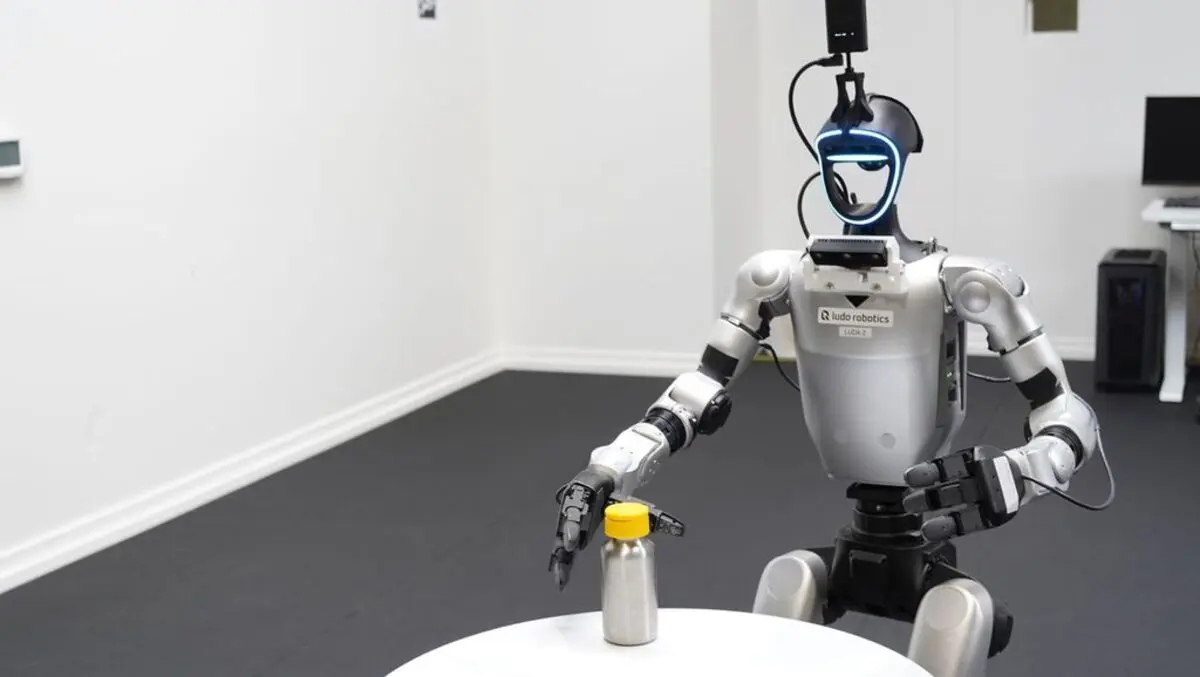

Krafton has unveiled Ludi 0.2, a robotic intelligence system developed by its subsidiary Ludo Robotics, marking the gaming group's latest move into robotics research.
The system is designed to help robots interpret human intent, respond to feedback, maintain context and react to changing situations. The work builds on Krafton's experience in artificial intelligence from game development, including virtual characters that interact with players in real time.
Ludo Robotics, based in Palo Alto with a research and development lab in Seoul, focuses on what it describes as socially intelligent robots. The unit is developing systems that move beyond fixed commands so machines can better understand context, human behaviour and shifting tasks.
Krafton is best known as the company behind PUBG: BATTLEGROUNDS, but its virtual worlds have also served as training grounds for AI because they involve large numbers of players whose actions are social, unpredictable and constantly changing. That work has included machine learning, reinforcement learning, large language models and multimodal AI, as well as AI teammates developed with Nvidia.
At the centre of the latest announcement is an updated version of Ludo's robotics software. An earlier version, Ludi 0.1, combined a vision-language model for reasoning and dialogue with navigation and manipulation functions. This enabled the system to interpret spoken instructions, ask clarifying questions and adapt tasks within supported environments.
Ludi 0.2 extends that work in several areas, including social intelligence, memory and reasoning, coordination between tools, gesture interpretation and physical movement.
In practice, the system is intended to improve how a robot reads social cues, understands gestures and adjusts its actions while carrying out physical tasks. The broader aim is to combine communication, reasoning and movement in ways that make interactions with people feel more natural.
"For nearly two decades, KRAFTON has built games and virtual worlds where people and intelligent systems interact in real time," said CH Kim, Chief Executive Officer of Krafton and Ludo Robotics.
"Through Ludo Robotics, we're building on that experience to explore how AI can better understand people and interact with them naturally in the physical world," Kim said.
Research push
One of the central challenges in robotics remains human understanding rather than physical execution. While robots have improved at carrying out actions, social interaction still presents a difficult technical problem because real-world behaviour can be ambiguous and variable.
Ludo Robotics is trying to address this by combining simulated environments, AI-generated social interactions and real-world human behaviour data. It is also developing benchmarks to assess how robots handle social situations involving different personalities, preferences and relationships, alongside gesture-driven physical manipulation.
Scientific leadership at Ludo Robotics includes Kangwook Lee, who serves as Chief AI Officer at Krafton and Chief Technology Officer at Ludo Robotics, alongside Chief Scientist Rob Nowak and Human-Robot Interaction Lead Yea-Seul Kim. The team's backgrounds span machine learning, embodied AI, robot learning and human-computer interaction.
"Robots are becoming increasingly capable of performing physical tasks, but understanding and responding to people remains a major challenge," said Kangwook Lee, Chief AI Officer at Krafton and Chief Technology Officer at Ludo Robotics.
"Ludi 0.2 represents another step toward our goal of bringing conversation, reasoning and physical action together so robots can better understand human intent, respond to feedback and adapt as situations change," Lee said.
Longer-term plan
The robotics effort forms part of a broader strategy to extend technology developed in gaming into other sectors. Ludo Robotics is also working on Ludi 1.0, a foundation model intended to combine perception, dialogue and physical action in one system.
The goal is for robots to maintain a shared understanding of tasks with people while communicating and acting in real time. That would place the company among a growing number of technology groups seeking to apply advances in generative AI and multimodal systems to machines operating in homes, workplaces and other real-world settings.
By setting up Ludo Robotics in Silicon Valley while retaining a research base in Seoul, Krafton is positioning the unit close to US academic and industry talent while linking it to its existing engineering base in Korea. The latest system is the clearest sign yet that the games publisher sees robotics as a serious research field rather than a side project.