

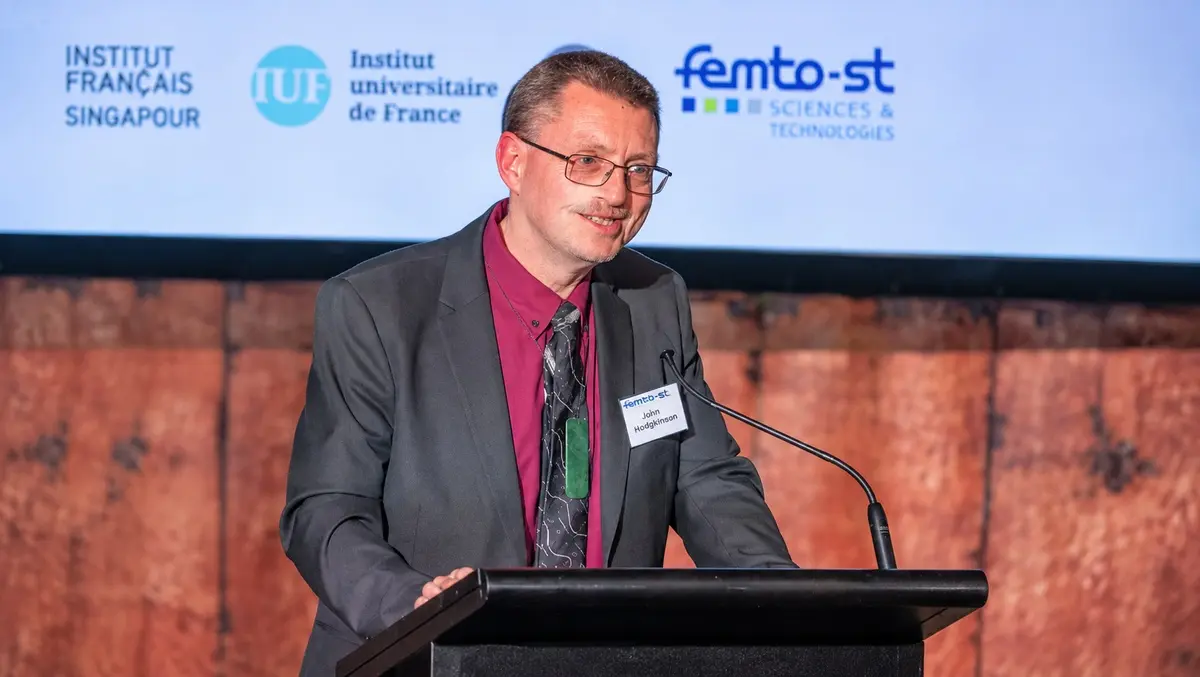
No matter what point in your science career you're at, I don't think you're ever settled, because there's always something new on the horizon, there are always possibilities. What I like right now is that I've got the freedom to choose what I do in a way that perhaps a younger researcher doesn't have. Young researchers really must follow the hot topics and they have to rush. I don't have to do that. I can take my time and maybe look at some of the directions that they're leaving. I love that freedom and the flexibility.
In countries like France and Germany, you're expected not only to research and teach, but also to inform debate in society. It's not just a question of being allowed to criticise government or even the university if you don't agree with what it's doing. I think it's part of our responsibility to be a critic and conscience of society. I think as science is becoming more and more confusing for society, that's something I've always done to some extent, linking science and society.
As you mature in your career, you can take risks
I've tried to be quite diplomatic, not to alienate any particular area, but as you mature in your career you can take risks. We all worry about how society is making decisions these days, and rationality seems to have taken a vacation. Decisions are being made based on all sorts of emotional, non-evidence-based criteria. Politicians aren't providing the leadership that they should. So someone has to step up and I think that's the traditional role of academics.
I don't think New Zealand researchers are paying as much attention to the development of science funding policy as European researchers. We follow the trends very closely because we have to. We read the work programmes, we read the preparatory documents, we respond to every submission. In New Zealand, researchers seem to be relying more on leadership, for example of the Dodd-Walls Centre, to do that for them. That's not how it should work. Specifically, if the Centres of Research Excellence are not renewed and that umbrella disappears, individual researchers may not be prepared to deal with it themselves.
I was asked about the tension between fundamental and applied science all the time during my trip to New Zealand, because my arrival was shortly after the Prime Minister's Science, Innovation and Technology Advisory Council published its report, Prioritisation in New Zealand's Science, Innovation and Technology System. In my view, a key difference between fundamental and applied science that we do not emphasise enough concerns the question of time scale. Fundamental science is curiosity-driven, it's freedom. You give scientists the time to follow all sorts of different directions. It's high risk. Most of the ideas won't yield any kind of concrete short-term outcome. Whereas applied research is more mission-based and targeted to something on a more defined timescale. Both approaches co-exist.
The brightest minds are attracted by the hardest questions
I think it can be justified for any country or institution to decide that they don't have the resources to fund everything and they have to focus on short-term objectives. But you need to be aware that when you do that, you're taking a very big risk. And that risk isn't not discovering something. It's that your young people will leave, because experience tells us again and again that the brightest minds are attracted by the hardest questions. They want to spend at least three or four years trying to solve the difficult problems of mathematics, or to locate dark matter, or reconcile quantum mechanics and gravity. The things which people tell them are impossible.
But if students leave because they can't work on such challenging problems in New Zealand, they probably won't come back. Then you risk losing some of the smartest people who would otherwise drive the economy. Indeed, across Europe, there's a very well-known problem that the inability to recruit qualified personnel is one of the biggest barriers to growth in small and medium-sized enterprises.
They're trying to fix this in several ways, including targeted and coordinated graduate education in key themes (including photonics). And for example, whilst society is seeing the tremendous growth and potential in the field of AI, a major bottleneck in the future will be linked to the hardware. In this area, we are going to need physicists to design the future physical architectures. This will include specialists in photonics to develop the integrated photonic platforms that will be necessary in the next decades to improve the energy efficiency of AI hardware.
A very strange relationship with higher education
New Zealand seems to have a very strange relationship with higher education. There are these debates about whether a degree is really worth it. The problem is that you can generate wealth for yourself more quickly if you train to be a plumber or an automotive mechanic. And of course these are essential professions. But if that becomes the dominant model of economic development, you risk creating an increasingly service-based economy without a sufficiently strong high-technology manufacturing sector. People have to realise that the country risks becoming increasingly dependent on external expertise, losing its national sovereignty in key areas of knowledge and technology.
You can see this to some extent in Europe, where countries have adopted different approaches to industrial policy. France and Germany have traditionally recognised that certain industrial capabilities are of strategic national importance and have been prepared to support them over long periods. And the UK is also now pursuing a more interventionist industrial strategy. So the idea that subsidies are necessarily a bad thing, which seems to be embedded in New Zealand's psyche, is simply not borne out by experience.
These technologies are small, but they can be exported easily
Where the sector can really build on the strengths in New Zealand is in the applied areas such as quantum sensing or single photon detection technologies, in fields like bio photonics and imaging, and advanced quantum detection for the space industry. That's where New Zealand could really invest very meaningfully. These technologies are small, but they can be exported easily. There's a lot of added value and the capital investment to work in these areas is low. It's where intellectual ingenuity can really make a difference.
But I also noticed the inevitable passage of time. The number of people who knew Jack Dodd and Dan Walls personally is decreasing every year. And the number who actually know about how New Zealand's excellence in these fields developed is also decreasing. Most of my contemporaries are now a few years away from retirement. I think it's really important that as the new generation takes over, they don't completely forget the huge history and traditions that put them in the position they're in.
It's just old-fashioned gratitude for the people who built the infrastructure that they're currently enjoying. And that's important because they have a certain responsibility of stewardship to make sure it continues.
Some of them will also have to take on the mantle of political leaders. In New Zealand, Paul Callaghan, Peter Gluckman and others have very successfully navigated this area of science policy, but there should be more people putting their hands up. However, I don't see that much willingness amongst scientists (at least those in photonics) to get involved.