

Sensors keep state highway 1 bridge open during works
Wed, 28th Oct 2026 (Today)
Viotel sensors were used on the Kaiapoi River Bridge to keep traffic on State Highway 1 moving at 80km/h during strengthening works. The bridge carries 30,000 to 35,000 vehicles a day.
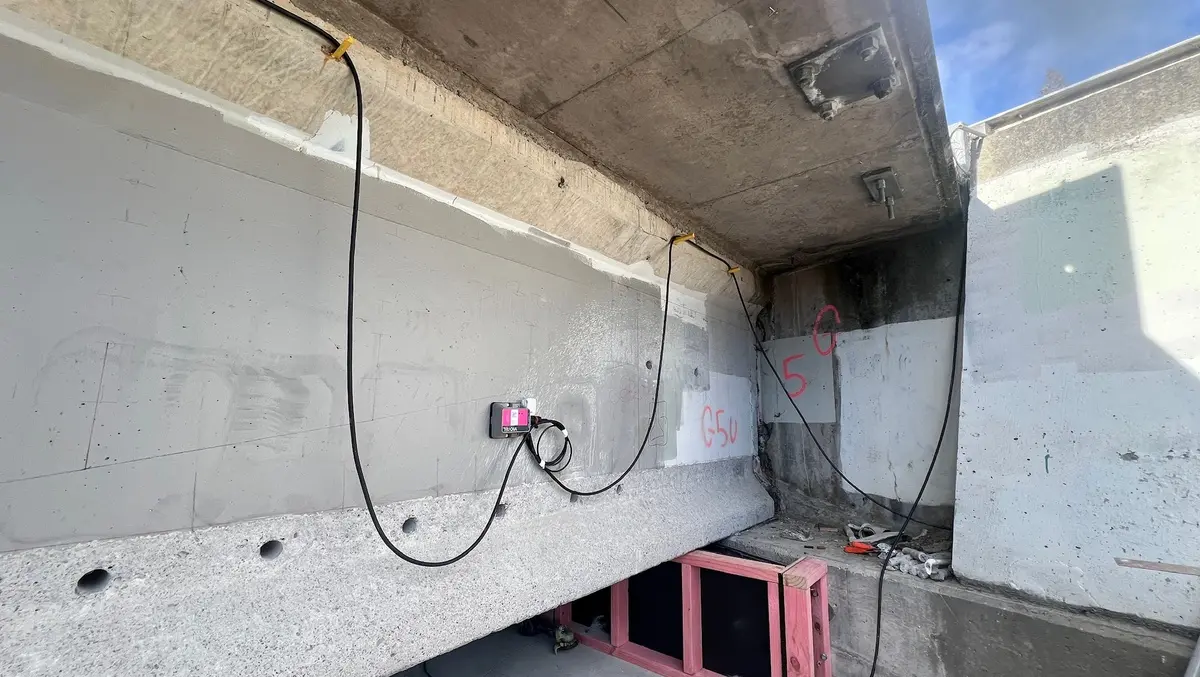
Eight sensors attached to the bridge north of Christchurch provided real-time vibration data while contractor Hunter Civil carried out concrete pours as part of early works for the NZ Transport Agency Waka Kotahi SH1 Belfast to Pegasus Motorway and Woodend Bypass project.
Engineers had expected to impose a 30km/h speed restriction during each pour and for at least three days afterwards because vibration from passing traffic could weaken the bond between new and existing concrete as the material cured. With closing the route ruled out, the project team looked for a way to measure the bridge's response directly rather than rely on assumptions.
Hunter Civil had planned the work around the lower speed limit but wanted a stronger technical basis for any change. It turned to Adroit, a New Zealand monitoring specialist, which brought in Viotel to help define what should be measured on the structure.
Patrick Connell, Project Manager at Hunter Civil, said the parties agreed live monitoring could provide an objective basis for the traffic decision. "We proposed vibration monitoring to the contract administrator and the client and they agreed: 'That's actually a way that we can all move forward with some confidence rather than it being an opinion or a guess'," he said.
Adroit arranged the equipment at short notice and sent a technician to install the sensors with Hunter Civil. Viotel supplied the wireless sensor units, the online monitoring software and support to interpret the results.
Each unit was fixed directly to the bridge and used an internal accelerometer to detect movement in three directions as vehicles crossed. The data was then sent over the Spark Cat M1 cellular network to an online dashboard for engineers to review.
Engineering check
The readings were compared with structural modelling by engineering consultancy Aurecon and with physical measurements taken on site. This gave NZTA, the contract administrator and Hunter Civil a shared basis for revising the traffic management plan while the concrete gained strength.
Matthew Montgomery, Lead Structural Bridge Engineer at Aurecon, said the monitoring changed the team's view of what speed limit was needed during the works. "We were predicting that we would need to drop the speed limit to 30 kilometres per hour to achieve what we wanted to," he said. "Whereas with the monitoring in place, we justified keeping the speed up at 80 kilometres per hour. So a significant shift there."
Hunter Civil also used NZTA traffic data to plan the two main pours on successive Fridays. That meant the earliest curing period fell on Saturdays, when traffic volumes and heavy vehicle movements were lower.
Both pours were completed with traffic continuing to use the bridge at 80km/h. For motorists on one of Canterbury's busiest road links, that avoided the delays that would have come with several days of sharply reduced speeds.
Bridge response
The monitoring also showed why one section of the bridge was vibrating more than others. Viotel reviewed the sensor output alongside CCTV footage and traffic movements to identify the source of the higher readings.
Joshua Seskis, Global Infrastructure Lead at Viotel, said the issue was linked to settlement on the road approach to the bridge. "You basically had a slump in the ground and the trucks go up and you get this dynamic impact effect," he said. "It was clearly isolated to that section and it was clearly detectable."
The finding gave engineers more than a short-term traffic management tool. It also provided direct evidence of how the structure was responding to normal traffic loads, which could be used in later decisions on maintenance and strengthening.
Guy Macpherson, General Manager at Adroit, said the starting point was to define the engineering problem before selecting the monitoring approach. "Before you just say, 'We've got the right technology,' you really need to make sure you can answer the problems they're trying to answer," he said. "In this case, the Viotel product met the requirements and we brought them into the conversation early on."
The work reflects a broader push by infrastructure owners to use live condition data on ageing assets rather than rely only on periodic inspections or conservative operating assumptions. On major transport routes, where closures are often impractical and lower speed limits carry economic costs, that can change how maintenance projects are planned and carried out.
Seskis said the wider value of this kind of monitoring lies in helping authorities manage existing assets under tight renewal budgets. "It's not the '50s. We're not building everything again. We're trying to manage the infrastructure we've already built."