

Siemens & NVIDIA build AI brain for future factories
Tue, 13th Jan 2026
Siemens and NVIDIA are expanding their partnership to develop what they describe as an industrial AI operating system that links design, engineering, manufacturing, and supply chain operations through shared artificial intelligence platforms.
The two companies said the collaboration will focus on industrial and physical AI systems that move from simulation to real-world deployment, supported by NVIDIA's AI infrastructure and Siemens' industrial software, hardware, and domain expertise.
"Together, we are building the Industrial AI operating system – redefining how the physical world is designed, built, and run - to scale AI and create real-world impact," said Roland Busch, President and CEO, Siemens. "By combining NVIDIA's leadership in accelerated computing and AI platforms with Siemens' leading hardware, software, industrial AI and data, we're empowering customers to develop products faster with the most comprehensive digital twins, adapt production in real time, and accelerate technologies from chips to AI factories."
"Generative AI and accelerated computing have ignited a new industrial revolution, transforming digital twins from passive simulations into the active intelligence of the physical world," said Jensen Huang, Founder and CEO, NVIDIA. "Our partnership with Siemens fuses the world's leading industrial software with NVIDIA's full-stack AI platform to close the gap between ideas and reality - empowering industries to simulate complex systems in software, then seamlessly automate and operate them in the physical world."
Lifecycle focus
The partnership centres on applying AI across the full industrial lifecycle, from early design and engineering to production, operations, and logistics. Siemens and NVIDIA said the goal is to support faster product development, continuous optimisation, and more resilient manufacturing.
A key element is the creation of adaptive manufacturing sites that rely on AI-driven digital twins. These systems analyse production environments, test changes in virtual models, and then apply validated improvements directly on the shop floor.
The first reference site will be Siemens' Electronics Factory in Erlangen, Germany. The companies said it will serve as a blueprint for future AI-driven manufacturing facilities.
Factories will use what Siemens and NVIDIA call an "AI Brain", combining industrial operations software with NVIDIA Omniverse simulation libraries and AI infrastructure. The system is intended to support real-time decision-making from design to deployment.
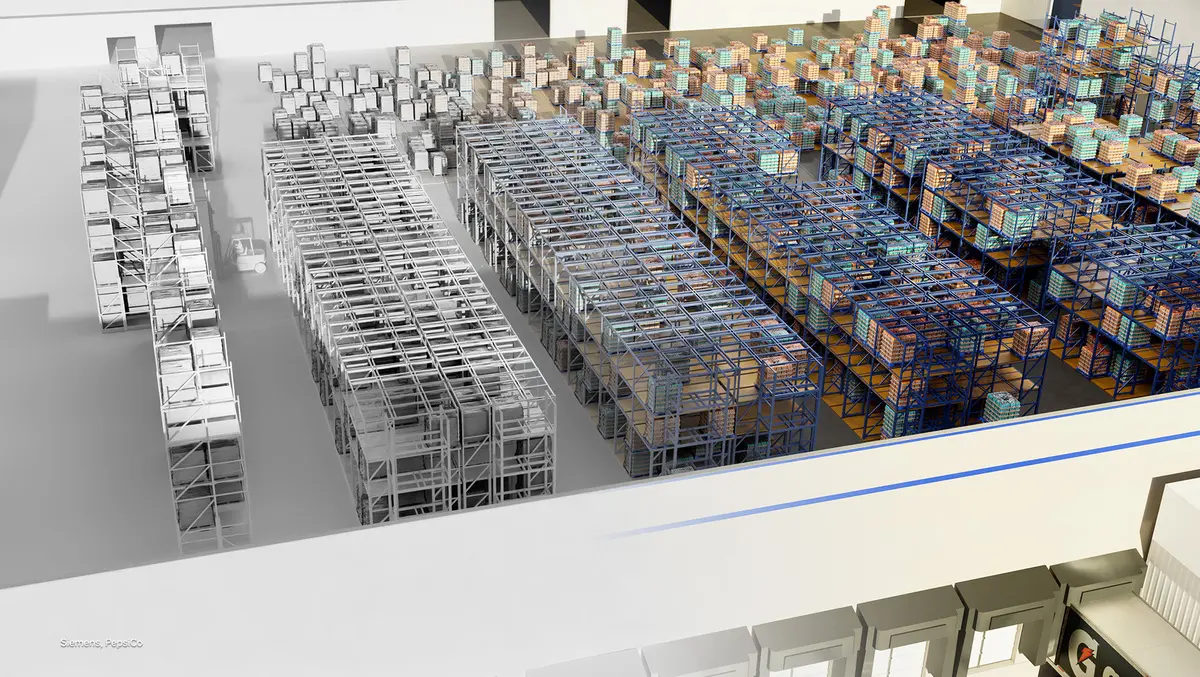
Several industrial groups are already evaluating elements of the approach, including Foxconn, HD Hyundai, KION Group, and PepsiCo.
Simulation acceleration
Siemens plans to complete GPU acceleration across its entire simulation portfolio. The company will expand support for NVIDIA CUDA-X libraries and AI physics models, allowing customers to run larger and more detailed simulations at higher speed.
The partners said this foundation will enable a shift toward generative simulation. NVIDIA PhysicsNeMo and open models will be used to develop autonomous digital twins capable of real-time engineering design and autonomous optimisation.
The companies said the aim is to shorten development cycles, reduce risk during commissioning, and improve reliability in production environments.
Semiconductor design
The partnership also targets electronic design automation for semiconductor and AI factory development. Siemens will integrate NVIDIA CUDA-X libraries, PhysicsNeMo, and GPU acceleration across its EDA portfolio.
The focus will be on verification, layout, and process optimisation. Siemens and NVIDIA said these changes are expected to deliver speed improvements of two to ten times in key workflows.
AI-assisted features such as layout guidance, debug support, and circuit optimisation will be added to improve engineering productivity while maintaining manufacturability requirements.
The companies said the approach supports AI-native design engines that combine verification, manufacturability, and digital twin methods in a single workflow.
AI factories
Siemens and NVIDIA are also developing a repeatable blueprint for next-generation AI factories. These facilities are intended to support high-density computing while addressing power, cooling, and automation requirements.
The blueprint covers the full lifecycle, from planning and design through to deployment and operations. It links NVIDIA's AI platform roadmap and Omniverse simulation with Siemens' power infrastructure, electrification, automation, and digital twin systems.
The companies said the objective is to accelerate deployment, improve energy efficiency, and strengthen operational resilience for industrial-scale AI infrastructure.
Internal deployment
Both companies plan to deploy the technologies within their own operations before offering them more broadly. NVIDIA will assess Siemens systems to optimise its internal processes, while Siemens will use NVIDIA platforms to accelerate its own workloads and integrate AI into its customer offerings.
The companies said this internal use is intended to provide reference cases that demonstrate scalability and operational value.
The partnership positions Siemens' industrial software portfolio alongside NVIDIA's AI infrastructure stack, with the shared aim of creating tightly integrated digital and physical workflows for industrial customers.