


The most expensive technology you own is the technology you don't use
Fri, 27th Nov 2026 (Today)
Somewhere in your organisation, there is probably a multimillion-dollar technology investment quietly underperforming. Nobody is particularly concerned because nothing is technically broken.
That's the problem. Keeping the lights on has become the definition of success.
Organisations don't always outgrow their technology. Sometimes they simply outgrow their implementation.
You spent millions. You built the business case, hired the consultants and committed your best people for months, if not years. Then you went live, and everyone exhaled.
The project was declared a success. The team disbanded. Executives moved on to the next strategic initiative. Business as usual resumed.
The project may be finished. The investment isn't.
Here is what happens next.
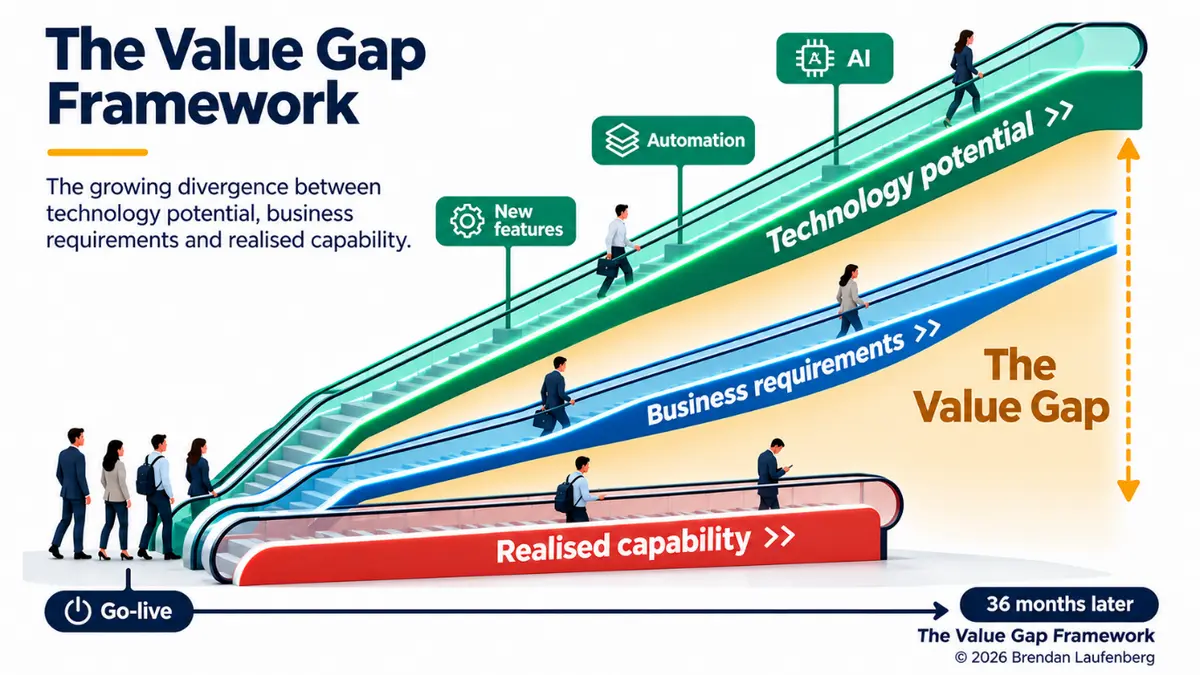 Figure 1: The Value Gap Framework. A conceptual model illustrating the growing divergence between technology potential, evolving business requirements and realised capability.
Assume the implementation was a success, and that technology potential, business requirements and realised capability were aligned on go-live day.
Slowly but surely, they start to pull apart.
Your technology vendor keeps investing, releasing new functionality, automation and AI. Every release introduces new opportunities to extract value.
Your business keeps moving. Customer expectations shift, new markets open, complexity grows and competitors sharpen.
Your system stays largely where it was on go-live day.
The gap between your system and your business requirements costs you operational efficiency. The gap between your system and your technology's potential costs you opportunity.
Together, they form what I call the Value Gap.
Left unmanaged, both continue to widen. Standing still is effectively going backwards.
We have changed the way we buy enterprise technology without changing the way we manage it.
Organisations have moved from purchasing software to subscribing to continuously evolving platforms. Yet many still operate as though they purchased a static piece of software ten years ago.
They have adopted the cloud commercial model without adopting the cloud operating model.
Cloud's great promise is continuous innovation, with no big-bang upgrades to unlock new capability. Depending on your subscription, much of it is already yours.
But receiving new functionality and capturing business value are two very different things.
Take a platform with two major releases a year. After three years, that's six rounds of innovation that did not exist on go-live day.
Here is a test. Name three features released in the last 12 months that your business now uses. If you can't, you have your answer.
Who has assessed them against your changing needs? Who has measured the value they delivered? And the harder question: who is responsible for asking?
Too often, nobody has clear accountability. When the project team disbands, the people left running the system are focused on keeping it stable, secure and supported. They are measured on uptime and closed tickets, not on whether the business is getting more from it. The system works, so "good enough" quietly becomes the standard.
If nobody can answer, the Value Gap is probably growing.
The cost goes well beyond unused features. When the system stops keeping pace, people work around it. Spreadsheets multiply, manual processes creep back, extra software is bought and more people are hired to manage the mess.
Each decision looks reasonable. Together, they build a fragmented, expensive and complex environment.
Then the executives ask whether the platform is still fit for purpose.
Back to market. More consultants. Another business case. Another procurement. Potentially millions more.
The irony is that the organisation may spend millions buying capabilities it already had access to.
But did the technology fail to keep pace with the business, or did the organisation fail to keep pace with its technology?
Replace the platform without changing how you adopt technology, and you simply reset the Value Gap and restart the cycle.
Now add AI to the picture.
AI isn't creating the Value Gap. It's accelerating it.
Two organisations could subscribe to exactly the same enterprise platform, pay comparable subscription fees and have access to the same AI capabilities, yet achieve dramatically different business outcomes.
The differentiator is no longer simply access to technology. It is the organisational ability to absorb innovation.
AI is democratising access to innovation, but it isn't democratising the ability to capitalise on it.
So how do you close the gap?
The most important question for any executive team: who is accountable for the investment after go-live?
Who revisits the business case? Who tests new functionality against changing requirements? Who measures the value it delivers?
Maintaining technology and realising its value are different jobs. A system can be operational, secure and reliable and still not be paying back.
The good news is that closing the gap doesn't necessarily require replacing your technology. It requires rethinking how you manage it.
Stop treating enterprise technology as a project with an end date. Run it as an ongoing programme of business improvement, built on four principles:
Own it. Assign a business executive accountability for ongoing value realisation, not simply system performance.
Review it. Assess every major technology release against evolving business requirements.
Measure it. Revisit the original business case and track commercial outcomes, not just system availability.
Align it. Ensure business processes and technology capabilities evolve together.
The business doesn't stop evolving at go-live. Neither does the technology. Why should your version of it?
The true cost of enterprise technology extends well beyond what you pay for it. It includes the gap between what you're paying for, what you've implemented and what your business now needs.
That gap is an opportunity cost. It never appears on an invoice, but it may be the most expensive thing you own