

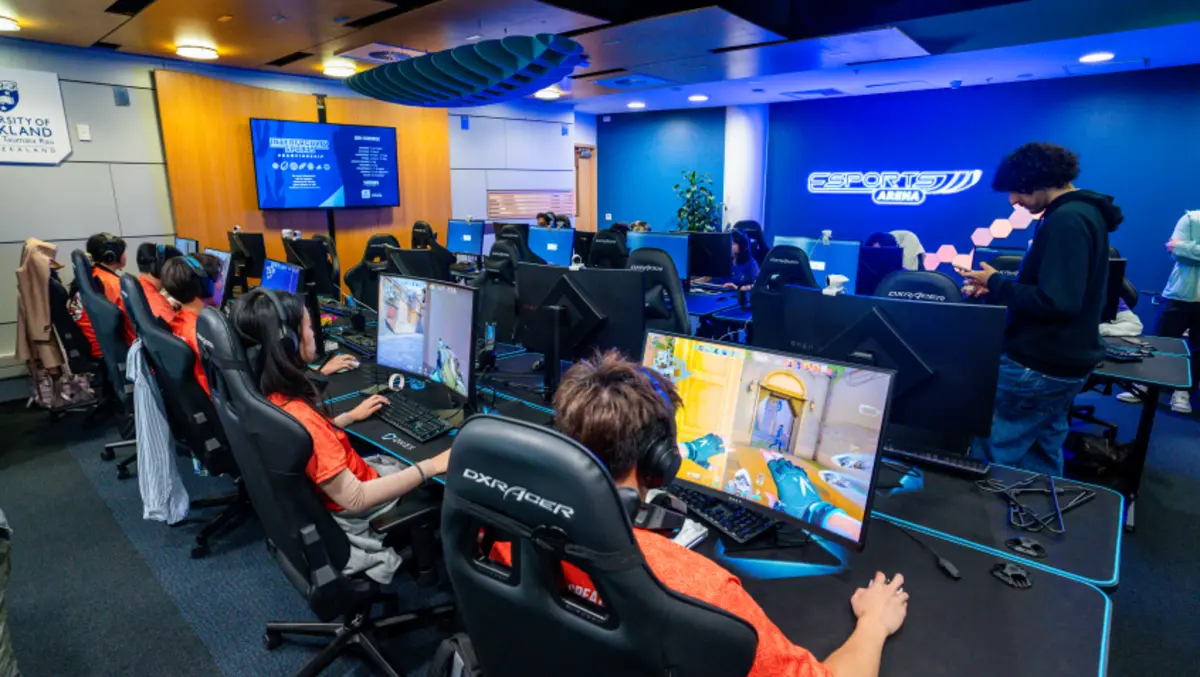
University of Auckland esports arena wins recreation award
Fri, 27th Nov 2026 (Today)
The University of Auckland's Esports Arena, Ātea, has won the Outstanding Recreation Facility Award at the 2026 Recreation Awards. The recognition highlights a university gaming venue credited with helping students build social connections.
Recreation Aotearoa presented the award, citing the arena's role in making gaming a shared activity rather than a solitary one. Survey data from student users showed that 89% had formed meaningful friendships through Ātea, while 86% said participation helped them feel more connected to university life.
Those figures offer a counterpoint to concerns that screen-based recreation weakens social ties. At the Auckland facility, gaming is tied to in-person interaction through a dedicated physical venue and a programme of events aimed at different student groups.
Since opening, the arena has expanded beyond its initial purpose of providing access to gaming equipment. It now hosts recreation activities, competitions, teaching and student work opportunities, and has supported more than 200 events since 2022.
In 2025, the venue recorded 1,740 active student participants, exceeding its annual target by 24%. Overall user satisfaction reached 94%.
The arena is also home to the Auckland University Esports Club, one of the university's largest student clubs, with hundreds of active members. Students use the space not only for play but also for event organisation, broadcasting, content production and tournament management.
Academic staff have also used the venue for teaching and research. Partnerships with organisations including the New Zealand Esports Federation have linked students to opportunities in the wider esports sector.
Inclusion focus
A central part of the arena's model is its focus on students who may not feel represented in more traditional sport and recreation settings. The venue has developed activities with student communities, including dedicated Rainbow gaming events and sessions for disabled students with lower-sensory environments and specialised gaming equipment.
Participation data suggests those efforts have widened the venue's reach. Women's participation rose from 18% in 2024 to 22% in 2025, while Māori and Pacific participation increased from 13% to 15% over the same period.
Rainbow student participation also increased, reaching 14% in 2026 after the introduction of targeted programming. Work with Māori student communities has also shaped activities, including Matariki celebrations and regular gaming events.
Affordability is also part of the venue's offer, with students able to use the gaming technology for $4 an hour. The arena also provides paid jobs and volunteer roles tied to its events and daily operations.
Barkin Sertkaya, Esports Coordinator at the University of Auckland, said the venue was designed to support both digital and face-to-face interaction. “Gaming allows you to connect with people anywhere in the world, but you can also bring your friends and peers into the arena and play alongside them. I see the arena as a hub for making friends and connecting with people,” Sertkaya said.
The university is also testing ways to combine gaming with more active forms of recreation. One example is HADO, an augmented reality game from Japan that combines digital play with the physical movement of dodgeball.
That work is part of a broader effort to connect esports with student wellbeing. “We're looking at ways to combine esports with physical activity and support the overall hauora of our students,” Sertkaya said.
Wider debate
The award comes as schools, universities and health bodies continue to debate the effects of screen time on young people. Recreation Aotearoa said the Auckland arena showed that digital recreation can support inclusion and social connection when structured around community participation.
Sarah Murray, Chief Executive of Recreation Aotearoa, said the venue challenged a one-dimensional view of gaming. “We hear a lot about the negative impacts of screen time, particularly when it comes to young people's wellbeing and social connection. But Ātea shows that the story isn't always that simple.
“Here is a facility built around gaming where 89% of users say they've formed meaningful friendships. That's a powerful reminder that recreation isn't defined by whether you're holding a controller or kicking a ball - it's about the opportunities to participate, connect and belong.
“Ātea isn't suggesting that all screen time is beneficial. What it demonstrates is that when digital recreation is thoughtfully designed and supported, it can be a genuine force for inclusion and wellbeing,” Murray said.
Ātea was among a wider group of winners recognised by Recreation Aotearoa for contributions to recreation and wellbeing across New Zealand.