

Verra Mobility brings crash prevention with Red Light Delay
Mon, 3rd Aug 2026
Verra Mobility has introduced Red Light Delay to the Australian market, positioning it as a way to help prevent right-angle collisions at intersections.
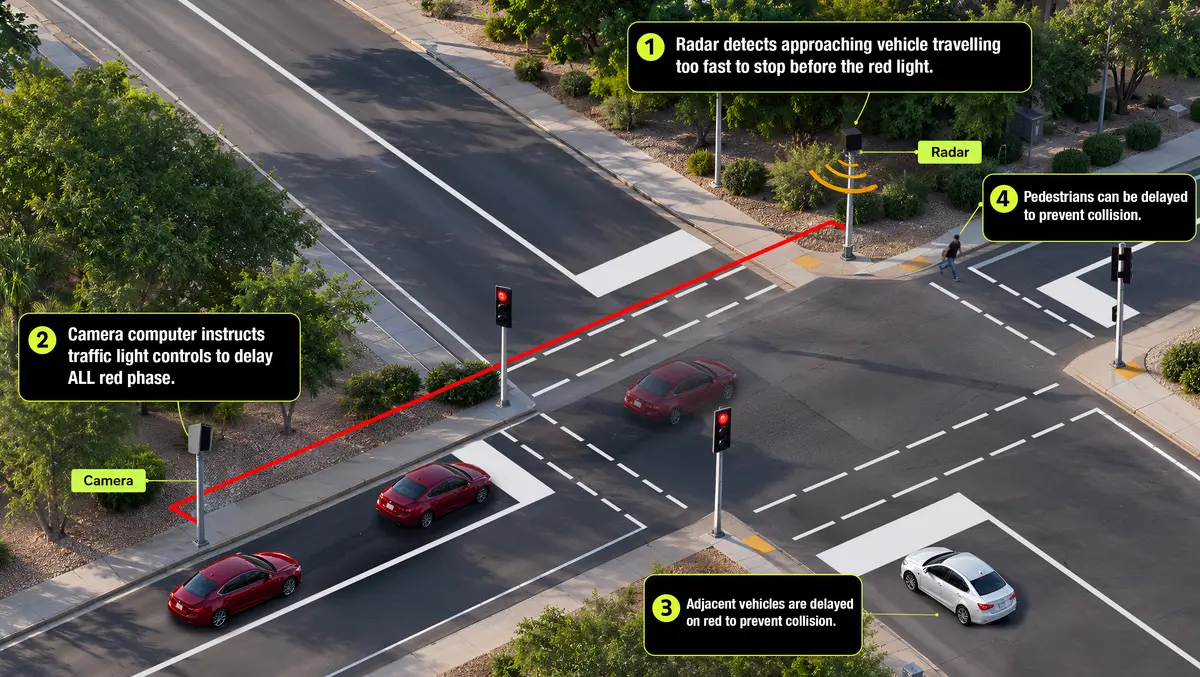
The technology uses radar to identify vehicles that are unlikely to stop safely before a red light. It then briefly delays conflicting traffic movements and, where configured, pedestrian movements, reducing the risk of a vehicle entering an intersection into the path of cross traffic.
The launch comes as road deaths in Australia continue to rise. National road fatalities increased 1.7 per cent last year to 1,314, extending a run of annual increases since 2021 and sharpening concern about serious crashes at intersections and traffic lights.
Right-angle crashes, often known as T-bone collisions, are among the most severe types of road accident because of the direct side impact on vehicles. Red Light Delay is intended to intervene at the point of risk rather than record an offence after a breach has already occurred.
In practice, the system works alongside traffic signals. When it detects a likely red-light violation, it sends a real-time signal to the traffic light control cabinet and extends the all-red phase for cross traffic, creating extra time before other vehicles enter the junction.
This marks a shift from conventional red-light cameras, which are used primarily for enforcement. Red Light Delay can work with new or existing enforcement cameras, and it can also operate as a standalone unit, giving road authorities different installation options across established and new road networks.
How It Works
The system can also be adapted to local traffic needs. One configuration allows authorities to pause a green pedestrian signal if a vehicle is judged likely to run a red light, helping keep pedestrians out of the intersection during a potential conflict.
That flexibility may matter for transport agencies managing different junction designs, traffic volumes and pedestrian activity levels. By allowing the technology to be integrated without replacing an entire enforcement setup, Verra Mobility is positioning the system for use across a range of jurisdictions.
Verra Mobility already operates traffic management and enforcement systems in Australia and overseas. Red Light Delay is being presented as an addition to those operations rather than a replacement for existing camera enforcement.
Steven Crutchfield, Senior vice president and managing director, international, at Verra Mobility, outlined the company's view of the technology's role in road safety.
"The impact is clear: safer streets for pedestrians and cyclists, and greater confidence for everyday drivers. Our goal is for prevention-first systems like Red Light Delay to become a standard feature of intersection design across Australia, reducing the number of people affected by preventable, high-speed crashes at traffic lights," Crutchfield said.
"Every Australian, wherever they are on the road, should be able to trust that the driver beside them at the red light will not become the reason they don't make it home," he said.
Broader Safety Push
Intersection safety has become a sharper focus for policymakers as the national road toll remains elevated. Traffic signals are intended to manage conflict points between vehicles, cyclists and pedestrians, but they can also become sites of severe impact when motorists fail to stop.
The significance of systems such as Red Light Delay lies in their attempt to change the sequence of response. Traditional camera enforcement is designed to deter dangerous driving through penalties and evidence capture, while this model adds a short operational intervention aimed at reducing the chance of a collision at the moment it is about to occur.
For road authorities, the appeal may rest on whether such systems can be added to existing infrastructure without major disruption. The product's compatibility with established enforcement cameras and its ability to run as a standalone installation could make deployment easier across varied road networks.
Australia's recent rise in road deaths has increased scrutiny on measures that can address severe crash types more directly. With right-angle impacts remaining among the most dangerous crashes on urban roads, intersection control systems focused on prevention are likely to draw attention from transport agencies looking for ways to reduce harm.
Verra Mobility operates across North America, Europe, Australia and New Zealand, with transport safety systems and parking management among its business lines.